


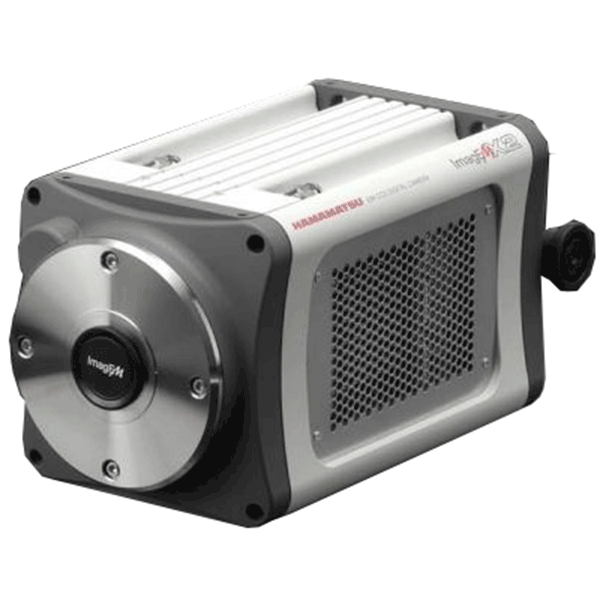
Hamamatsu ImagEM X2 C9100-23B
Couldn't load pickup availability
Follow Us Online!
For an official Quote Email us at info@mundaymicroscope.com
International Buyers - Please Request Quote with ship to address
Have questions or need Faster Shipping? Call 919-775-5596
Hamamatsu ImagEM X2 C9100-23B
The ImagEM X2 is an extremely versatile camera that quietly delivers 70 frames/s at full frame and up to 1076 frames/s with analog binning and regions of interest. With very high signal to noise in near dark conditions and extremely low dark current, the ImagEM X2 enables quantitative ultra-low light imaging both for long integration times and at high speed. With EM gain off, the extremely deep full well capacity can extract information from the lowest contrast bright images. Additional new features allow for optimized camera triggering, on-board for EM gain protection, streamlined connectivity through IEEE1394b, improved overall signal to noise and increased non-EM dynamic range. Hamamatsu has taken the beloved 512 _ 512 EM-CCD sensor and created a masterfully redesigned camera that delivers maximum speed and precision performance.
The ImagEM X2-1k(C9100-23B) 1024 x 1024 version is also available.
Hungry for Photons
With large pixels, high QE, and relatively zero readout noise, EM-CCD technology performs in low light conditions. How low light? When you've got fewer than 10 photons per pixel between the sample and background, EM-CCDs are the perfect tool for the job, delivering the best SNR of any camera technology. For high mag, biologically relevant applications with routine exposure times of 10 ms to 30 ms, the sample is likely emitting hundreds to thousands of photons per pixel. But with faster speeds come shorter exposure times, risking the ability to capture more than tens of photons per pixel in one shot and therefore pushing the application into the ultra-low light zone. The ImagEM X2 makes these super-fast exposures possible and has the sensitivity to provide visually pleasing and quantitatively meaningful images in a photon-starved environment.
New Features
Faster readout
By clocking pixel readout at 22 MHz, the ImagEM X2 is able to achieve 70 frames/s with full frame resolution. That's more than 2_ the original ImagEM and is faster than any commercially available camera using the sensor.
Clock: 22 MHz
| Binning | Effective vertical width (Sub-array) | ||||||
| 512 | 256 | 128 | 64 | 32 | 16 | ||
| 1_1 | 70.4 | 133 | 241 | 405 | 613 | 820 | |
| 2_2 | 131 | 238 | 400 | 606 | 813 | 981 | |
| 4_4 | 231 | 389 | 588 | 794 | 962 | 1076 | |
(Unit: frames/s)
Corner readout
By selectively imaging at the edge of the sensor, closest to the read register of the chip, it is possible to achieve even greater speeds of small ROIs.
Clock: 22 MHz
| Binning | Effective vertical width (Sub-array) | ||||||
| 512 | 256 | 128 | 64 | 32 | 16 | ||
| 1_1 | 70.4 | 133 | 285 | 495 | 741 | 893 | |
| 2_2 | 131 | 238 | 456 | 699 | 901 | 981 | |
| 4_4 | 231 | 389 | 645 | 863 | 981 | 1076 | |
(Unit: frames/s)
Lower readout noise
In any image sensor, faster readout means increased readout noise. Yet readout noise is considered irrelevant for EM-CCDs because of the EM gain. Remarkably, the ImagEM X2, even before applying EM gain, has faster speed and lower read noise than its predecessor. But didn’t we just say readout noise in EM-CCD was irrelevant? Yes, in SNR equations this is true. However, if the primary purpose of EM gain is to overcome readout noise, then this will be accomplished with less gain in the ImagEM X2 and less voltage in the EM register, translating into theoretically more stable EM gain calibrations and greater sensor longevity.
| Readout noise (rms) (typ.) | EM-CCD readout | EM gain 4_ | 36 electrons (at 22 MHz) |
| 25 electrons (at 11 MHz) | |||
| 8 electrons (at 0.6875 MHz) | |||
| EM gain 1200_ | 1 electron max. (at 22 MHz) | ||
| 1 electron max. (at 11 MHz) | |||
| 1 electron max. (at 0.6875 MHz) | |||
| NORMAL CCD readout | 8 electrons (at 0.6875 MHz) | ||
Mechanical shutter
The ImagEM X2 includes an integrated mechanical shutter in order to protect the camera from EM gain degradation and to lessen afterimage effects. The mechanical shutter is software controlled.
EM gain measurement and calibration
Gain aging is a known and expected process in EM technology. Even when every care is taken to minimize gain aging, use of the camera in EM mode, especially with high gains or high intensity light, can degrade the gain. Since this is a use-dependent phenomenon, it's important to know when it's happened and to have the ability to easily recalibrate. These two functions in the ImagEM X2 make this crucial maintenance of the camera software accessible and user friendly.
IEEE 1394b connectivity
The data rates of the ImagEM X2 are well suited to the trusted and easy to use 1394b connectivity.
SMA triggering ports
In its new incarnation, the ImagEM X2 sports four shiny and compact SMA ports, one for input of an external trigger and three for output to other devices. These ports can be used to access an array of triggering options including three additional features: programmable trigger input/output, trigger delay and trigger ready. There is no denying that EM-CCD technology offers the best SNR for ultra-low light imaging, and the ImagEM X2 offers the fastest speeds combined with multiple engineering enhancements to allow you to make the most of this technology.
Direct electron display
Output signal can be indicated in "electrons" instead of pixel AD counts in application software.
Black Clip / White Clip function
It enables setting an upper or lower threshold of intensity. If there is a brighter or darker location than a sample of interest in an image, this function allows clipping the upper limit or lower limit of intensity to make Auto LUT function work effectively.
Cooling status output
The camera indicates when it has reached the target cooling temperature.
Features
High Sensitivity
High QE
High EM gain of maximum 1200_
EM gain feature is ideal for live cell imaging because of shorter exposure times and reduced excitation light levels.
Low Noise
Minimal dark noise is another benefit of stable cooling performance
The dark current of a CCD depends on the temperature, and it decreases by half when the temperature drops by approximately 7 to 8 ¡C. Therefore, cooling a CCD is a very good way to reduce dark current noise. The ImagEM X2's stable cooling enables stable output and its water cooling minimizes dark current.
Highly stabilized control of sensor temperature with either water or forced-air cooling
Water or forced-air cooling is selectable for any application, and optimal cooling temperature can be set in each cooling mode.
Optimized sensor drive methods significantly reduce the clock induced charge (CIC)
Dark current consists of thermal charge and clock induced charge (CIC). CIC will dominate the dark charge in the images taken at short exposure time, and thermal charge will dominate the dark charge in images taken at longer exposures. The camera is adjusted to use the optimized drive method suitable to the scan speed. The biologist doesn't have to think about CIC optimization for long or short exposures. The camera handles it automatically.
Great Stability
Highly stabilized EM gain by cooling temperature control
Maintaining stable cooling temperature is essential to stable gain settings required for superior performance in long duration imaging and analysis. Very precise control of the cooling temperature in the ImagEM X2 is a key benefit.
Stability of mean bias value (Digitizer Offset)
The baseline is constant over time providing signal stability for long term measurements.
EM gain protection
It is important to operate the camera in ways that minimize the rate of gain aging and extend the life of the camera. The ImagEM X2 protects EM gain in two levels: EM gain warning and EM gain protection. EM gain protection mode stops charge transfer through the EM gain register when excessive output conditions have occurred which may damage the sensor.
EM gain readjustment *
Over time all EM-CCD cameras exhibit gain degradation. The EM gain can be readjusted by raising the voltage in the multiplying register. The EM gain readjustment can be done by software which comes with the camera. However, the number of times the EM gain can be readjusted is limited.
*This feature is available when the camera is operated with DCAM-API. (DCAM-API is a software driver which supports HAMAMATSU digital cameras.)
Selectable Readout Modes
Select a readout mode for optimal image acquisition based on the sample brightness or desired frame rate or exposure time.
An often overlooked benefit of EM-CCD technology is the ability to utilize the camera as a standard CCD. In non-EM mode, there is no effect of excess noise, and the large full well capacity and high dynamic range are ideal for bright light applications that have large intrascene dynamic range. The ImagEM X2 provides a low read noise non-EM mode that can be an ideal choice for such applications.
Photon Imaging Mode
This is a unique technology to improve image quality at very low light level to overcome the limitation of excess noise factor from the electron multiplying process. This mode is most useful for signal levels at which maximum EM gain has no apparent signal or very little signal. The mode preserves quantitative linear signal output and also improves spatial resolution at very low light levels.
On-board Image Processing
The following real time processing functions are available.
-
Background subtraction
Effective for reducing fluorescence in image backgrounds. -
Shading correction
This feature corrects the shading or uneven illumination in microscope images or other illumination systems. -
Recursive filter
This feature provides random noise elimination in an image by weighted time based averaging. -
Frame averaging
This feature provides noise elimination in an image by simple frame averaging and less “afterimage” effect than the recursive filter. -
Spot noise reducer
This image processing function operates on random spots of intensity by comparing incoming images and eliminating signals that meet the criteria for noise in one image but not in others. This processing eliminates noise elements like cosmic rays.
Applications
・Protein-protein interaction
・Calcium waves in cell networks and intracellular ion flux
・Real time spinning disk confocal microscopy
・Single molecule imaging with TIRF microscopy
・Fluorescence in-vivo blood cell microscopy
・Gene expression imaging using luminescence
Specifications
| Type number | C9100-23B |
|---|---|
| Camera head type | Hermetic vacuum-sealed air/water-cooled head*1 |
| Window | Anti-reflection (AR) coatings on both sides, single window |
| AR mask | Yes |
| Imaging device | Electron Multiplying Back-Thinned Frame Transfer CCD |
| Effective number of pixels | 512 (H)512 (V) |
| Cell size | 16 μm (H)16 μm (V) |
| Effective area | 8.19 mm (H) 8.19 mm (V) |
| Pixel clock rate (EM-CCD readout) | 22 MHz, 11 MHz, 0.6875 MHz |
| Pixel clock rate (NORMAL CCD readout) | 0.6875 MHz |
| EM (electron multiplying) gain | 4 to 1200 (typ.)*2 |
| Ultra low light detection | Photon Imaging mode (1, 2, 3) |
| Fastest readout speed | 70.4 frames/s to 1076 frames/s |
| Readout noise (EM-CCD readout) | 36 electrons (EM gain 4, at 22 MHz) (rms) (typ.) 25 electrons (EM gain 4, at 11 MHz) (rms) (typ.) 8 electrons (EM gain 4, at 0.6875 MHz) (rms) (typ.) 1 electron max. (EM gain 1200) (rms) (typ.) |
| Readout noise (NORMAL CCD readout) | 8 electrons (at 0.6875 MHz) (rms) (typ.) |
| Full well capacity | EM-CCD readout: 370 000 electrons (Max. 800 000 electrons) (typ.)*3 NORMAL CCD readout: 140 000 electrons (typ.) |
| Analog gain | EM-CCD readout (22 MHz): 1 EM-CCD readout (11 MHz/0.6875 MHz): 0.5, 1 Normal CCD readout: 1, 2, 3, 4, 5 |
| Cooling temperature (Forced-air cooled) | At temperature control: -65 ℃ stabilized (0 ℃ to +30 ℃) At maximum cooling (typ.): -80 ℃ (Room temperature: stable at +20 ℃) |
| Cooling temperature (Water cooled) | At temperature control: -80 ℃ stabilized (Water temperature: +20 ℃) At maximum cooling (typ.): -100 ℃ (Water temperature: lower than +10 ℃) |
| Temperature stability (Forced-air cooled) | ±0.01 ℃ (typ.) |
| Temperature stability (Water cooled) | ±0.01 ℃ (typ.) |
| Dark current (Forced-air cooled) | 0.005 electron/pixel/s (-65 ℃) (typ.) |
| Dark current (Water cooled) | 0.0005 electron/pixel/s (-80 ℃) (typ.) |
| Clock induced charge | 0.0015 events/pixel/frame (typ.) |
| Exposure time (Internal sync mode) | 13.9 ms to 1 s (22 MHz) 27.2 ms to 2 h (11 MHz) 421.5 ms to 2 h (0.6875 MHz) |
| Exposure time (External trigger mode) | 10 μs to 1 s (22 MHz) 10 μs to 2 h (11 MHz, 0.6875 MHz) |
| A/D converter | 16 bit |
| Output signal/External control | IEEE1394b |
| Sub-array | Every 16 lines (horizontal, vertical) size, position can be set |
| Binning | 2_2, 4_4, 8_8, 16_16*4 |
| External trigger mode | Edge trigger, Level trigger, Start trigger, Synchronous readout trigger |
| Trigger output | Exposure timing output, Programmable timing output (Delay and pulse length are variable.), Trigger ready output |
| Image processing features (real-time) | Background subtraction, Shading correction, Recursive filter, Frame averaging, Spot noise reducer*5 |
| EM gain protection | EM warning mode, EM protection mode |
| EM gain readjustment | Available |
| Lens mount | C-mount |
| Power supply | AC 100 V to 240 V, 50 Hz / 60 Hz |
| Power consumption | Approx. 140 VA |
| Ambient storage temperature | -10C to + 50 ¡C |
| Ambient operating temperature | 0C to + 40 C |
| Performance guaranteed temperature | 0 ¡C to + 30C |
| Ambient operating/storage humidity | 70 % max. (with no condensation) |
*2 Even with electron multiplying gain maximum, dark signal is kept at a low level during low light imaging.
*3 Linearity is not assured when full well capacity is over 370 000 electrons, because of CCD performance.
*4 8_8 and 16_16 binning are available on special order.
*5 Recursive filter, frame averaging, and spot noise reducer cannot be used simultaneously.
Commonly Asked Questions
Please refer to our commonly asked questions section to find out more information about Microscope Marketplace's payment, shipping, return and warranty policies