


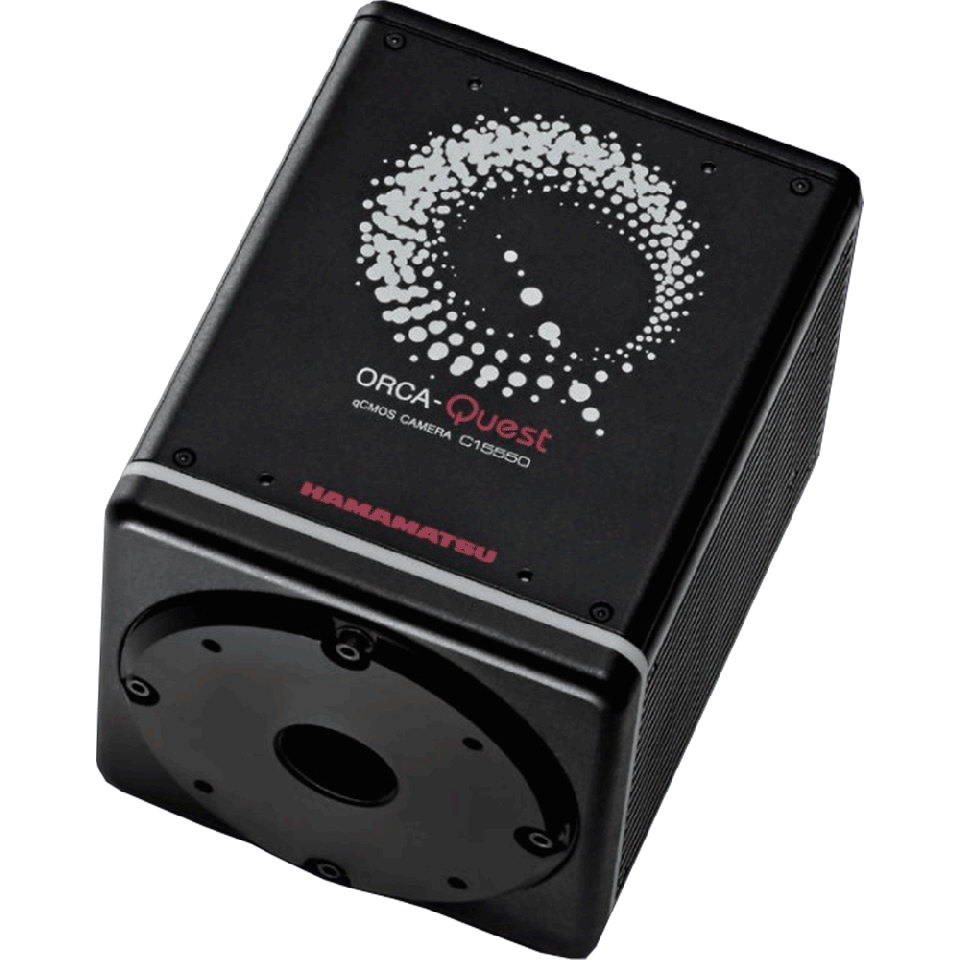
Hamamatsu ORCA-Quest II qCMOS camera C15550-22UP
Couldn't load pickup availability
Follow Us Online!
For an official Quote Email us at info@mundaymicroscope.com
International Buyers - Please Request Quote with ship to address
Have questions or need Faster Shipping? Call 919-775-5596
Hamamatsu ORCA-Quest II qCMOS camera C15550-22UP
Groundbreaking in concept and unprecedented in performance.
Since the 1980s, Hamamatsu Photonics has continued to develop high-sensitivity, low-noise cameras using its unique camera design technology and has always contributed to the development of cutting-edge scientific and technological research. The ORCA-Quest is a camera with a qCMOS image sensor developed using our unique design technology and the latest manufacturing techniques. It is also the world's first camera that achieves the ultimate in quantitative imaging by photon number resolving.
Evolution from ORCA-Quest
Faster ultra quiet scan mode
ORCA-Quest had achieved the level to realize photon number resolving owing to ultra-low noise characteristic in ultra quiet scan mode. However, this availability was limited for users because the ultra-low noise was available only when the camera operated in 5 frame per second (in full resolution).
ORCA-Quest 2 has achieved 5 times faster framerate with a similar ultra-low noise characteristic by optimizing the sensor operation. Photon number resolving feature has become available for most of users now!

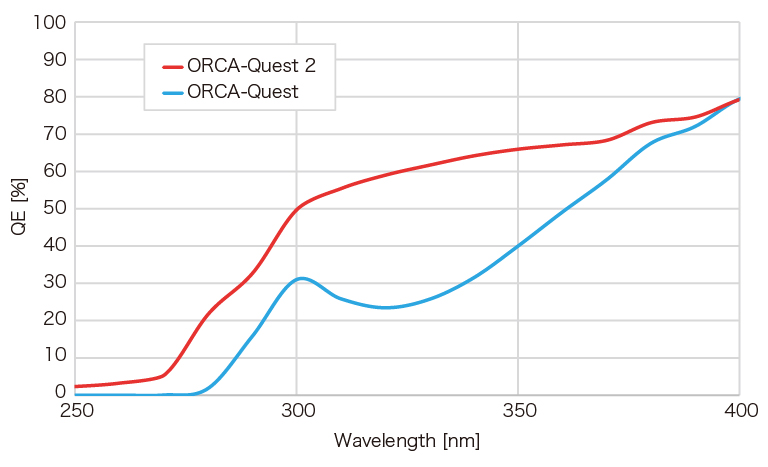
UV QE improvement
ORCA-Quest possessed high quantum efficiency (QE) in UV region around 280 nm-400 nm, compared to most of conventional scientific cameras.
Inspired by market needs, ORCA-Quest 2 has achieved even higher UV QE by optimizing AR coating of the sensor window, with no change of visible, near infrared wavelength region. The QE improvement expands the versatility of ORCA-Quest series in many kinds of application such as trapped ion quantum experiment.
Raw data output
The feature allows you to apply any algorithms to estimate the number of photoelectron from raw digital signal.
Faster edge trigger mode
The new edge trigger mode enables you to input an external trigger and start exposure during rolling shutter readout, resulting in a faster frame rate.
Four key features
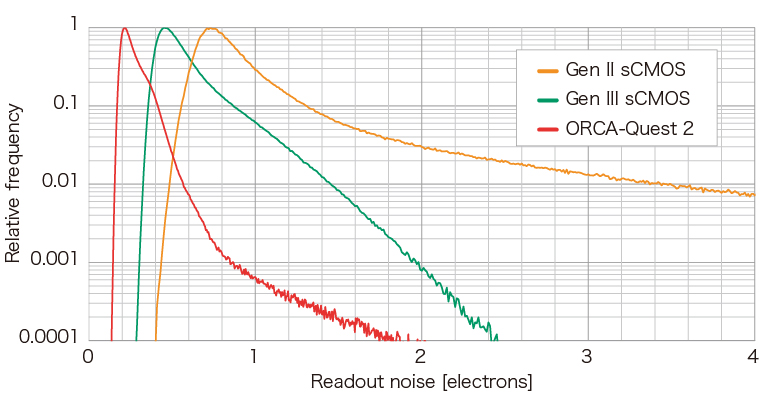
In order to detect weak light with high signal-to-noise, ORCA-Quest 2 has been designed and optimized to every aspect of the sensor from its structure to its electronics. Not only the camera development but also the custom sensor development has been done with latest CMOS technology, an extremely low noise performance of 0.30 electrons has been achieved.
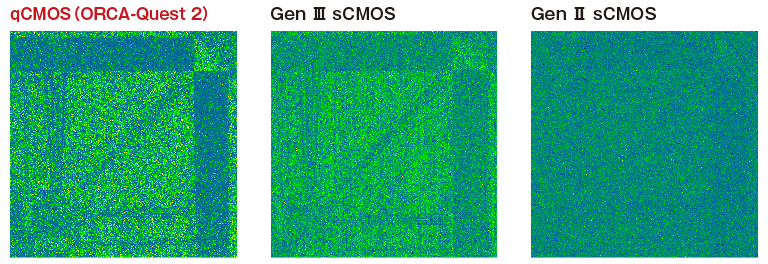
Comparison of average 1 photon per pixel image (pseudo-color)
Exposure time: 200 ms LUT: minimum to maximum value Comparison area: 512 pixels × 512 pixels
White paper
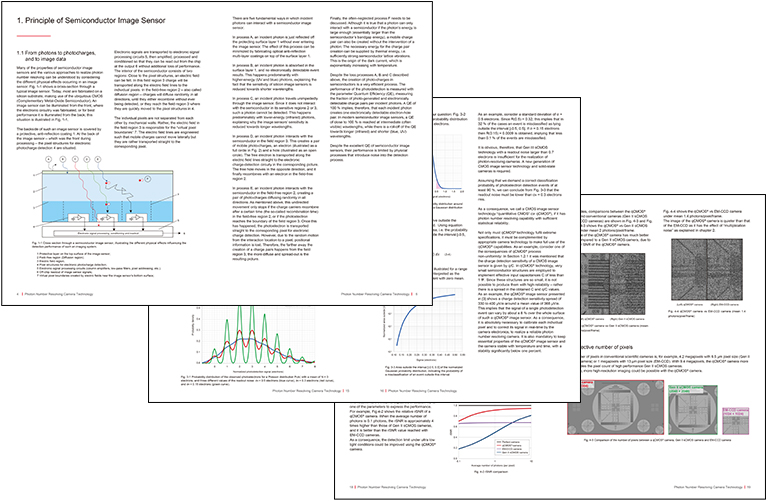
The evolution of imaging technology is directly linked to new scientific achievements. Scientific imaging has moved many experiments from relying on subjective recording into objectively documentable, repeatable, and quantifiable methods. Demanding and extremely valuable techniques such as single-molecule-based methods would not be possible without appropriate image sensors. The novel quantitative CMOS (qCMOS) technology finally reaches the physical limit: reliable quantification of photon numbers within each pixel, eliminating the influence of technology on the “triangle of frustration” (resolution, sensitivity, speed). This white paper discusses the new image sensor technology that is at the heart of the qCMOS camera. Topics include the semiconductor image sensor, the state of the art approaches to quantitative semiconductor image sensors, The qCMOS image sensor, and the challenges for photon number resolving.
Find detailed information in our White Paper below.
White paper[1.95 MB/PDF]
Webinar
We are at the dawn of a new era in CMOS and scientific imaging technology. To fully appreciate why the release of our new ORCA-Quest quantitative CMOS (qCMOS) camera with photon-number resolving technology is an engineering feat that can enable new paths of discovery in biology, physics, astronomy and quantum research, we invite you to watch our launch-day webinar by Dr. Peter Seitz. Dr. Seitz will briefly review the history of semiconductor image sensors and the principles of sensor design and show how applying the principles of photon and camera noise combined with advances in semi-conductor manufacturing culminated in the world’s first qCMOS technology.
Laurin Publishing Company, Inc. are producers and owners of the recording from May 19, 2021.
- SEE THE WEBINAR

Camera articles
qCMOS camera vs. EM-CCD camera – Performance comparison of Photon counting cameras
The qCMOS camera is positioned as an ultra-sensitive camera that offers the ultimate in quantitative imaging because of its extremely low noise performance. Therefore, when comparing a qCMOS and EM-CCD camera it is necessary to judge which camera is best suited to your application.
The purpose of this article is to compare qCMOS and EM-CCD cameras to help you choose the best camera for your application.

Applications
Neutral atom, Trapped ion
Neutral atoms and ions are aligned one by one in an array to be utilized as Qubits for Quantum computing. The qubit states can be determined by observing the fluorescence from each of them. The measurement of the fluorescence needs to be done in short time and then photodetectors with very low noise and high speed are needed. ORCA-Quest 2 can do both of diagnosis of the whole qubit array and state detection of each qubit with very low noise characteristics and high speed readout. Also, the QE covers wide range of wavelength for major ion and atom species.

Fluorescence imaging of Rb atom array with ORCA-Quest
Data courtery of: Takashi Yamamoto and Asst. Prof. Toshiki Kobayashi, Osaka University
Quantum optics
Quantum optics uses single photon sources to make use of the Quantum nature of the single photon.The quantum optics research also uses single photon counting detectors, and now there are emerging needs of photon number resolving detectors to distinguish photon numbers coming into the detectors.A photon counting camera, a new concept in camera technologies, is expected to make a new discovery in this field.

Experimental setup of Quantum imaging with ORCA-Quest

Images of Quantum imaging with ORCA-Quest
Data courtery of: Miles Padgett, University of Glasgow
Case study

Imaging single atom array by ORCA®-Quest for Neutral Atom Quantum Computing

Mid-circuit imaging by ORCA®-Quest qCMOS® camera in an error-corrected neutral-atom quantum computer

40Ca+ imaging by ORCA®-Quest for optical clock application
Publications
- ORCA-Quest
PC recommendation
With the introduction of the ORCA-Quest, users are now able to stream 9.4 megapixel images to their computers 120 frames per second. The computer recommendations for this high data rate can be met by using the guidelines listed this PC Recommendations for ORCA-Quest.
PC Recommendation for ORCA-Fire / Quest2 / FusionBT / Fusion.pdf [588 KB/PDF]
Software

Software
Our software provides the interface to access all of our carefully engineered camera features, from simply setting exposure to orchestrating complex triggering for multidimensional experiments.
Specifications
| Type number | C15550-22UP |
|---|---|
| Imaging device | qCMOS image sensor |
| Effective no. of pixels | 4096 (H) × 2304 (V) |
| Cell size | 4.6 μm (H) × 4.6 μm (V) |
| Effective area | 18.841 mm (H) × 10.598 mm (V) |
| Quantum efficiency | 85 % (peak QE) (typ.) |
| Full well capacity | 7000 electrons (typ.) |
| Readout speed | Standard scan*1: 120 frames/s (At full resolution, CoaXPress), 17.6 frames/s (At full resolution, USB) Ultra quiet scan, PNR, Raw *2: 25.4 frames/s (At full resolution, CoaXPress), 17.6 frames/s (At full resolution, USB) |
| Readout noise | Standard scan: 0.43 electrons rms (typ.), 0.39 electrons median (typ.) Ultra quiet scan: 0.30 electrons rms (typ.), 0.25 electrons median (typ.) |
| Exposure time | Standard scan*1: 7.2 μs to 1800 s Ultra quiet scan, PNR, Raw *2: 33.9 μs to 1800 s |
| Cooling temperature | Forced-air cooled (Ambient temperature: +25 °C) : -20 ℃ Water cooled (Water temperature: +25 °C)*3 : -20 ℃ Water cooled (Max cooling; The water temperature is +20 ℃ and the ambient temperature is +20 ℃) *3: -35 ℃ (typ.) |
| Dark current | Forced-air cooled (Ambient temperature: +25 °C) : 0.016 electrons/pixels/s (typ.) Water cooled (Water temperature: +25 °C) : 0.016 electrons/pixels/s (typ.) Water cooled (Max cooling; The water temperature is +20 ℃ and the ambient temperature is +20 ℃) : 0.006 electrons/pixels/s (typ.) |
| Dynamic range | 23 000 : 1 (rms) (typ.), 28 000 : 1 (median) (typ.)*4 |
| External trigger mode | Edge / Global reset edge / Level / Global reset level / Sync readout / Start |
| External trigger signal routing | SMA |
| Trigger delay function | 0 s to 10 s in 1 μs steps |
| Trigger output | Global exposure timing output / Any-row exposure timing output / Trigger ready output / 3 programmable timing outputs / High output / Low output |
| External signal output routing | SMA |
| Image processing functions | Defect pixel correction (ON or OFF, hot pixel correction 3 steps) |
| Emulation mode | Available (ORCA-Quest, ORCA-Fusion) |
| Interface | USB 3.1 Gen 1, CoaXPress (Quad CXP-6) |
| A/D converter | 16 bit, 12 bit, 8 bit |
| Lens mount | C-mount*5 |
| Power supply | AC100 V to AC240 V, 50 Hz/60 Hz |
| Power consumption | Approx. 155 VA |
| Ambient operating temperature | 0 °C to +40 °C |
| Ambient storage temperature | -10 °C to +50 °C |
| Ambient operating humidity | 30 % to 80 % (With no condensation) |
| Ambient storage humidity | 90 % Max. (With no condensation) |
*1: Normal area readout mode only
*2: PNR mode and Raw mode can be switched via DCAM configurator. The PNR mode is selected by default.
*3: Water volume is 0.46 L/m.
*4: Calculated from the ratio of the full well capacity and the readout noise in ultra quiet scan
*5: A product for F-mount (C15550-22UP01) is also available. If you wish, please contact your local Hamamatsu representative or distributor. F-mount has a light leakage due to its structure and it might affect your measurements especially with longer exposure time.
Commonly Asked Questions
Please refer to our commonly asked questions section to find out more information about Microscope Marketplace's payment, shipping, return and warranty policies